Another main character present in this story is the turtle (sea turtle in technicality due to the setting being in an ocean, but most characterisations do follow more of a land turtle’s), who function as the communicator between the sea king and the rabbit due to it being the only animal to ‘travel through both the water and the land. I wanted to put more focus on the sea turtle elements to my character, so I have simplified the shape of a sea turtle into two shapes: the teardrop shape which comprises the head and the limbs, and the ‘muffin’ shape which composed the body or the shell. Photo of a sea turtle by NFWF Then, as I have with the rabbit character, I analysed turtle characters from famous media. I have suspected that sea turtles would not be a common character since ocean-focused cartoons are very specific and rare, and my search had shown as such. Land turtles were more common to be used, with the rare exception of the sea turtle Crush from the movie ‘...
I had a follow up tutorial after the Student Talk, discussing on the progress on my project. Link to Tutorial Sheet Right now, I would have to finish up my 2D work (practice and final presentation) and the 3D work. The wood carving project had taken more time than I had anticipated, and it would be impossible to finish another wood maquette within the time frame so I would be changing the second 3D piece to something that can be made quicker such as air-drying clay. The 2D part would not take very long to finish, so I will continue focusing on the 3D project.
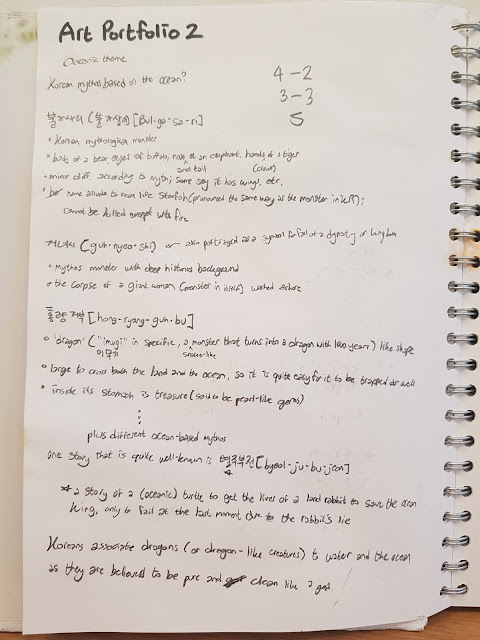
Like how we were given three themes to work off of in Art Portfolio One, we were again given three themes to develop our ideas. I feel like they are quite similar to the general ‘idea’ of the themes from last term, where it is composed of one abstract theme which is up for interpretation, one art movement or painting style and the last theme being of nature or Earthly themed. The three themes that were given to us were: Spiders from Mars, Renaissance and Oceanic. Oceanic theme was the first and most attractive theme that had caught my eye; ocean or water-related themes were quite common in Korea, so I had thought that I would be able to integrate parts of my culture into this theme. My initial thought process involved integrating ocean-based mythology into this project, which later developed into integrating oceanic children’s tale (one that I have thought of was ‘별주부전‘ [Byeol-Ju-Bu-Jeon], a story of a oceanic turtle and a rabbit). I had also taken a more direct approach to...


good work - please follow your plan and ensure you complete your work each week
ReplyDelete