Posts

Initial Research: Beatrix Potter

Image
 Before I look at children’s book illustrator from my country, I decided to research some famous illustrators that have could work with Korean watercolour style. One famous watercolour and children’s story writer-illustrator was Beatrix Potter, the creator of the well-known character ‘Peter Rabbit’ and many others.  The Tale of Peter Rabbit (2004) by Beatrix Potter  Beatrix Potter was noted for intricate watercolour and ink works (gouache in some cases) containing both elements from Realism and Fantasy elements. This was quite unique in her times, where if an animal were to be ‘humanised’ they behaved more like a human with an animal look while Potter’s animals were more animal-like with human abilities including being able to stand with two feet (The Collector, 2022). Perhaps this was why her works were effective for children; not only is her work visually attractive and something that could be seen in real life (due to her Realistic style), the whimsical nature and the ...
Planning Primary and Secondary Research: Researching pt. 3

Image
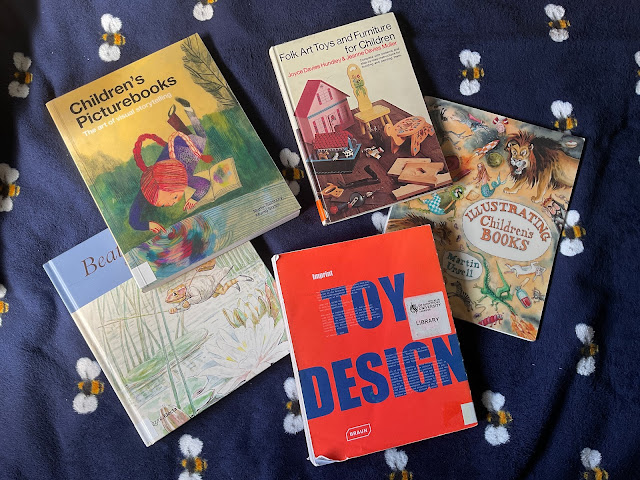
  For the second part of the lecture, we went to the library to find books for our secondary research. This would not only serve as a part of our artist research but also as background research which may be used to support our works (possibly as a bibliography). We were required to borrow at least two books which relate to our project and I had borrowed five books in total, three of which related to children’s book design (and artist) and the remaining of children’s toy design samples. I may visit the library in the future to find more necessary books as needed. For now, I would be prioritising with the illustration part of this project.  

Planning Primary and Secondary Research: Researching pt. 2

Image
 For today’s lecture, we have visited the Castle Gardens to sketch as a part of our primary research. While it may not directly have a major impact on my work, I observed the patterns and colours of nature as the setting for my children’s story both revolve around the oceanic setting and the forest setting.  Collage of the photos take during the trip  In these photos I have been focusing on the patterns of the objects nearby including the shapes of the leaves, trees and the bricks used in the buildings. I also looked at how there were complimentary colours on the plants, and how similar colours were present in nature. During my sketches I have realised that I could possibly use this shapes in the oceanic setting as well, in a way that corals can replace the shapes of trees and bushes. Otherwise I had attempted simplification on the animals to show the overall composition and texture of the animal while not making it complicated.  Sketches from the trip

Art Portfolio 2: Major Project Plan Pro Forma

Image
 Below is the Major Project Form for this project:  Link to Major Project Plan  The detailed outline of my project can be seen in the plan pro forma including my SMART objectives, motivation and working timescale. Here is an excerpt of my timescale from the plan sheet: ————— Week Three:  Week Four: Initial Research (At least one Primary and Secondary), Material Sourcing, Further Sketching Week Five: [Skills Week] Start working on final pieces, research into the artists mentioned previously Week Six: Continue developing final pieces (ideal if 2D is finished by here), additional research on children’s toys Week Seven: Start finishing up final projects, additional primary research on background presentation Week Eight: Finish up any unfinished work, take photo of the 3D project, do mockups and photoshop as needed Week Nine: Preparation and presentation of final works (website and blog) ————— After this post, I will continue to post my primary researches (majorly materi...

Planning Primary and Secondary Research: Material Resourcing and Scaling pt. 1

Image
    I have been looking into different materials to research for this project including different types of paper, paints and 3D materials. As I have not gathered materials for the 2D project yet, I will be discussing more into the 3D materials I have access to in this post.  Wood is a common material used in children’s toy that I had access to for this project. While plastic is a common materials as well, I neither do not have access to it nor the ability to shape it in the way I want. Wood has been a ‘natural’ medium that is (mostly) shatter and damage proof, which makes it an ideal materials for children who are prone to dropping objects and getting into accidents.   The current wood blocks are quite small, so I may have to go to the Wood Workshop to gather bigger ones and use this for practice. The wood type of this block is Pine wood, which is quite notorious for its simplicity and problems for carving. Only a select type of pine woods are suitable for ...

Background Information: Summary and Context Behind Byeol Ju Bu Jeon [The Hare’s Liver]

Image
  Cover Illustration of ‘ The Hare’s Liver ’, illustrated by Ye Jung Jo   The Hare’s Liver, also known as The Story of the rabbit,  is a traditional Korean fairytale and a type of Aesop’s Fable (stories revolving around animal characters to teach moral to children) which criticises the division between the rich and the poor (between the royalty and the common folk during its time of creation) and how the weak can overcome crisis through wit and wisdom. Below is the overview of this story by KOREA.net (Ministry of Culture): ‘ As the story goes, the Dragon King, the king of the sea, was deathly ill. His subjects suggest that a hare’s liver could cure him, yet none of them are brave enough to venture onto land to get the liver— that is, until the turtle volunteers. Once ashore, the turtle finds a rabbit and persuades him to visit the underwater kingdom, where great riches, beauty, and honor—the turtle claims—await. The rabbit agrees.   Back underwater, in the audience o...

Art Portfolio 2: Tutorial and Sign Off

Image
  To start the project, I have had my tutorial to further discuss on what I will be doing in this term. My tutor and I have discussed the contents of my project with the SMART Objective post I have uploaded, which now has minor revisions in phrasing to make my project more clear, and discussed some techniques and materials that I could use in my project.  Link to Sign Off Sheet    As this project will be working around children’s books and toys, it would be important to adjust my art styles to suit a child’s mind. Children tend to have shorter attention span and have to avoid intense stimuli (too bright colours, intense patterns, flashing and such) so a major factor to consider in this project is to create a straightforward and tame work. To do this, I will be researching into illustrators who have worked on children’s books and toy designs, followed by experimentation on which materials will be suitable in context of this project (Korean culture).